Buying blenders and juicers for small kitchens usually goes wrong in the same way. You shop for the smoothie you picture yourself making and not the one you actually make on a Tuesday at 6:40 in the morning, and you end up with either a 64 oz pitcher that does not fit under the cabinet or a 17 oz cup that struggles with frozen mango. The fix is not a fancier spec sheet. It is matching four things to your routine: how many drinks you make per session, whether ice and frozen fruit are in the mix, whether you want juice or a smoothie, and how many inches of counter you are honestly willing to surrender.
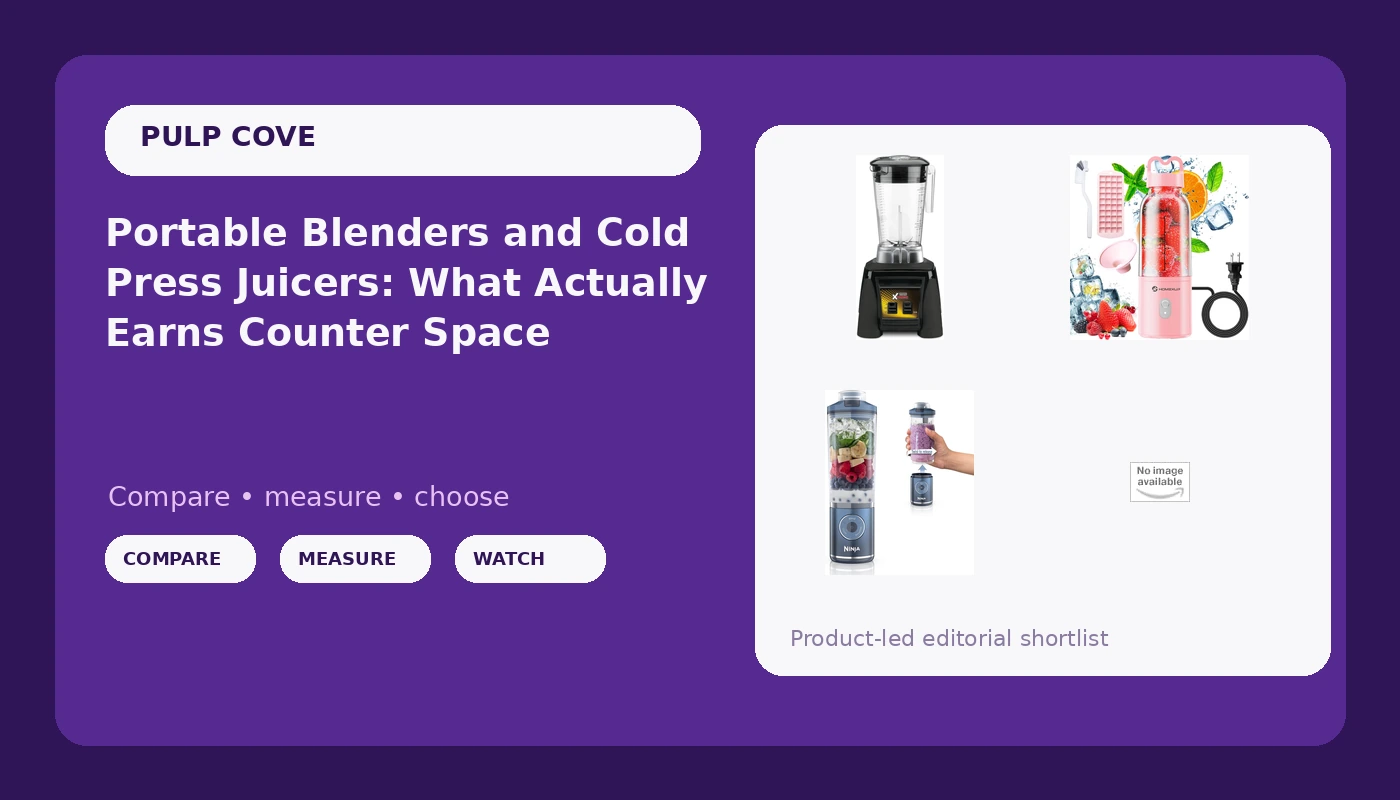
This guide covers four very different machines: a commercial 3.5 HP blender with a 64 oz container, a 22 oz portable blender, a 17 oz personal blender, and a cold press juicer. Each one is built for a different job, and none of them is built for all of them.
Related: Frozen Fruit Without the Slush Brick: Getting Smoothie Texture Right →
Quick answer
Match the machine to the routine, not the other way around. For one drink at a time, a 17 to 22 oz personal blender is the right footprint. For two or more people, regular ice, or a week of batches, a full size machine with a 64 oz container and a high-output motor is the one that will not frustrate you. If you want juice rather than smoothies, a cold press juicer extracts more from leafy greens and generally produces less foam than a centrifugal machine, but it is slower and has more parts to rinse. Buy for your most common drink, not your most ambitious one.
Four useful options
| Model | Best fit | What stands out |
|---|---|---|
| Waring Commercial MX1000XTX 3.5 HP Blender | High-volume batches, frozen drinks, back-to-back service | 3.5 HP motor, 64 oz BPA-free copolyester container, paddle switches with a pulse function |
| Ninja Blast Max Portable Blender | One or two drinks, blended and taken with you | 22 oz capacity and twist-and-go operation in a portable format |
| HOMEXUP Portable Personal Blender | The lowest-cost single-serve setup | 175W motor and a 17 oz cup |
| Cold Press Juicer Machines | Daily greens and juice-first routines | Slow cold press extraction instead of centrifugal spinning |
The high-volume workhorse: Waring Commercial MX1000XTX 3.5 HP Blender
The trade-offs here are footprint, cost, and the reality of washing a 64 oz jar for one smoothie. It runs on 120V with a 5-15 plug, so it is built for a standard North American outlet, but a machine this size wants permanent counter space and clearance under the cabinet. If you blend once a day for yourself, the container volume is more than you need and a full jar is more to clean. If you blend for a family, batch for the week, or crush ice often, the capacity and the motor headroom are the whole reason to pay for it.
The portable daily driver: Ninja Blast Max Portable Blender
The trade-off is capacity and repeatability. If two people want a smoothie, you are running two cycles, and 22 oz is the practical ceiling for one serving with ice. What it buys you is a machine you will actually use on a rushed morning: no pitcher to assemble, no tamper, no full teardown at the sink. Check the listing for what ships in the box, since cup, lid, and blade assembly details are worth confirming before you commit.
The budget starter: HOMEXUP Portable Personal Blender 17oz, 175W Smoothie Maker, Pink
Wattage is where expectations should be set. A 175W motor has far less headroom than the full size machines, so softer blends such as yogurt, banana, berries, protein powder, and milk are its natural territory. Dense frozen loads and a cup packed with ice are where a small motor works hardest, so load in layers, keep liquid in the cup, and give it time rather than filling to the rim. What you get is a low-commitment machine that fits in a cupboard and rinses in a minute.
The juice-first pick: Cold Press Juicer Machines
Because the listing name does not spell out capacity, motor, or included accessories, check the product page for the feed chute size, the number of parts, and whether a cleaning brush is included. Cold press juicers generally mean slower feeding, more prep, and more disassembly, and in exchange you get drier pulp and juice that holds together longer before separating. If you only juice oranges at breakfast, a handheld reamer is simpler and lives in a drawer instead of taking up counter space.
Prices and availability may change. Product images, names, and retailer links must be matched by verified ASIN. Do not state a current price, rating, stock status, or measured result without current evidence.
What wattage and horsepower actually tell you
Wattage and horsepower describe the motor, not the finished drink. A 175W personal blender and a 3.5 HP commercial machine are both called blenders, but they solve different problems: the small motor is designed for single servings of soft ingredients, while the commercial motor is designed to hold speed under a full 64 oz load of frozen fruit and ice. Horsepower figures on blenders are often peak ratings rather than continuous-duty ratings, which is part of why two machines with similar numbers can behave very differently in a kitchen.
Blade geometry, jar shape, and loading order matter just as much as the motor. A wide, short jar with blades at the bottom pulls ingredients down into the cut zone. A narrow jar encourages bridging, where frozen chunks spin in an air pocket above the blades and never get cut no matter how long you run the machine. Loading matters too: liquid first, then soft ingredients, then frozen fruit and ice on top, which gives the blades something to grab. Overfilling is the most common reason a lid pops off mid-blend, so fill to the marked line rather than to the rim.
Cold press versus centrifugal juicing
Centrifugal juicers shred produce with a fast spinning disc and then fling the pulp against a mesh basket, separating juice by force. They are quick and they handle firm produce well, but they whip air into the juice and the basket needs brushing afterward. Cold press juicers, also called slow or masticating juicers, crush and squeeze instead of shredding, running at low speed. In practice that means a slower feed, more prep time, and more parts to wash, offset by higher yield from leafy greens and juice that separates more slowly. For greens-heavy daily juicing, the cold press approach is the one that tends to justify the extra cleanup. For one glass of orange juice a week, it is a lot of machine for the job.
- Count your daily servings. One person, one drink: 17 to 22 oz. Two or more, or a week of batches: 64 oz.
- Decide whether ice is non-negotiable. Frozen fruit and ice are the hardest thing you will ask a blender to do, and motor headroom is what keeps texture even.
- Separate juice from smoothies. A blender makes a pulpy drink by design; a juicer removes the pulp. Pick one, or accept two machines.
- Measure the space. Height under the cabinet matters as much as footprint, especially for a 64 oz pitcher on a tall base.
- Check the parts list and the plug. Confirm cup, lid, blade assembly, tamper, and cleaning brush on the product page, and confirm the voltage suits your kitchen.
Practical guidance before you buy
- Measure the counter footprint and the height clearance first, because a machine that does not fit gets stored, and stored machines do not get used.
- Match container size to serving count. A 64 oz jar is a chore for one person and a convenience for four.
- Plan for cleanup. Fewer parts and genuinely dishwasher-safe components matter more on weekday mornings than any preset program.
- Load in the right order: liquid, soft ingredients, frozen items last, and never above the fill line.
- Think about noise timing. If you blend before sunrise in an apartment, decide in advance where the machine lives and how often you will run it.
- Verify included accessories and plug type on the listing, since those details are not always in the product name.
Which option should you choose?
Choose the Waring Commercial MX1000XTX 3.5 HP Blender when you blend for several people, batch for the week, or need a 64 oz container and a motor that holds speed through frozen loads. Choose the Ninja Blast Max Portable Blender when you make one or two drinks and want the machine to travel with you. Choose the HOMEXUP Portable Personal Blender when you want the simplest, smallest single-serve setup and mostly blend soft ingredients. Choose the Cold Press Juicer Machines when juice rather than smoothies is the point and you are willing to trade speed and cleanup time for yield on greens.
One caveat on evidence: the Cold Press Juicer Machines listing name does not describe capacity, motor, or accessories, so verify those details on the product page rather than assuming them. Prices, availability, and ratings on Amazon change constantly, which is why each callout above points you to the current listing instead of printing a number that can be stale by tomorrow.
The bottom line
The right machine is the one that matches your most common drink and fits the space you have. If that is a single morning smoothie, a 17 to 22 oz personal blender gets the job done without taking over the counter. If it is a full pitcher of frozen fruit for a household, the capacity and motor headroom of a 64 oz machine are worth the footprint. If it is greens juice every day, a cold press juicer earns its space. If it is one glass of orange juice, a reamer in a drawer will do. Pick the routine first, then the machine.