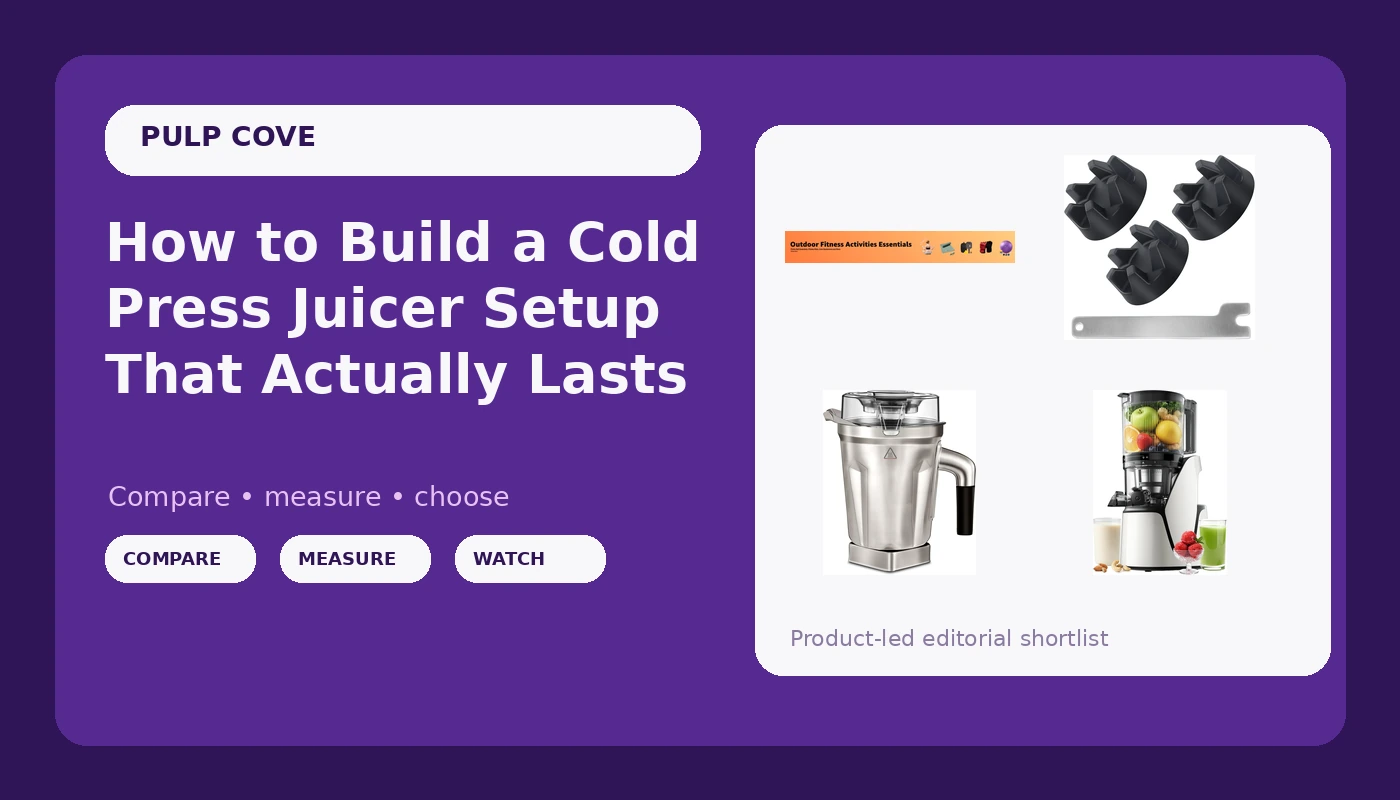
If you have spent an evening comparing juicers, you already know the sticker price is only the first line item. A working cold press juicer setup also includes a container you can pour from without a funnel, a feed chute wide enough that you are not dicing carrots into matchsticks before sunrise, and a plan for the wear parts that give out long before the motor does. That last one is the line item almost nobody budgets for, and it is the reason one machine ends up in a closet while another keeps running for years.
This guide covers four items that solve different parts of that problem. Two are juicing machines aimed at different routines. One is a container upgrade for people who already own a Vitamix and blend their greens instead of pressing them. One is a small replacement part that keeps an existing blender out of the trash. None of them is a universal answer, and the right pick depends far more on your counter space and your actual morning routine than on any spec sheet.
Related: Cold Press vs Centrifugal Juicers: Which One Fits Your Morning? →
Quick answer
There is no single machine that covers every kitchen, but the split is fairly clean. Choose a 3-in-1 cold press juicer when you want one appliance claiming several jobs and you have cabinet room for the extra parts. Choose a single-purpose cold press juicer with a wide feed chute when you juice smaller batches and want less to store. Choose a 64-ounce stainless steel container when you already own a Vitamix and the pitcher itself is what limits your batch size. Keep a replacement coupler in mind if you own a KitchenAid KSB5WH, KSB5, or KSB3, because the drive connection is usually the first thing to wear. Everything below explains how those four pieces fit together and what to verify before ordering.
Four useful options
| Model | Best fit | What stands out |
|---|---|---|
| EanOruus Juicer Machines, 3-in-1 Cold Press Juicer, Bright White | Juicing daily with more than one job in mind | A 3-in-1 cold press design in a bright white finish |
| Godspeeds 6-inch Chute Cold Press Juicer Machine | Smaller kitchens and shorter juicing sessions | Cold press design with a 6-inch feed chute named in the title |
| Pure Realm 64-Ounce Stainless Steel Container for Vitamix Blenders | Vitamix owners whose pitcher limits batch size | 64-ounce stainless steel container listed for Vitamix blenders |
| 9704230 Blender Coupler Replacement Parts for KitchenAid KSB5WH KSB5 KSB3 | Reviving a KitchenAid blender with a worn drive connection | Replacement coupler listed for KSB5WH, KSB5, and KSB3 |
The main machine: EanOruus Juicer Machines, 3-in-1 Cold Press Juicer, Bright White
The appeal of a multi-function machine is obvious: one footprint, one cord, one thing to wipe down. The trade-off is parts. A 3-in-1 almost always ships with attachments, screens, or drums that need somewhere to live when they are not in use, and those parts need washing after every session. Before you commit, read the listing to confirm exactly which three functions are included, what each one requires you to swap, and whether the parts are dishwasher safe. Multi-function machines also tend to be taller than single-purpose ones, which matters if your cabinets are low.
The budget cold press: Godspeeds 6-inch Chute Cold Press Juicer Machine
A wider chute is not a marketing number, it is time. Every inch of opening is an inch of apple you do not have to quarter, and in a small kitchen that difference shows up in how often the machine actually gets used. The counterweight is that a single-purpose juicer only does one thing, so if you also want to blend or grind, you are buying a second appliance. Cold press machines of this style run slowly by design, which is part of why they extract well from leafy greens and part of why a full session takes longer than a centrifugal juicer would. Plan for the slower pace, and check the listing for what the chute will and will not accept whole.
The container upgrade: Pure Realm 64-Ounce Stainless Steel Container for Vitamix Blenders
Two containers is not greed, it is workflow. Plenty of people run one pitcher for wet blends and keep a second for dry work like grains and spices, and stainless steel has a practical advantage here: it does not pick up the smell of yesterday's garlic the way some plastics can. The important caution is compatibility. Containers are matched to specific bases and lid assemblies, so confirm that this one fits your exact Vitamix model and that your existing lid and blade assembly work with it before you order. A 64-ounce container is also heavy when full, which is worth thinking about if you pour one-handed.
The cheap fix: 9704230 Blender Coupler Replacement Parts for KitchenAid KSB5WH KSB5 KSB3
The coupler is the small piece that mates the pitcher to the motor base, and it is a wear item. It takes the torque of every frozen blend, and when it finally gives, the symptoms look like a dying motor: the pitcher rocks, the blade slows under load, and thick blends stall. That is often a part problem, not a machine problem. Before ordering, match the part number to your model plate and look up how the old coupler separates from the pitcher base, because the removal step varies. Do the swap on a clean counter with the pitcher empty, and you may get years more out of a blender you already own.
Prices and availability may change. Product images, names, and retailer links must be matched by verified ASIN. Do not state a current price, rating, stock status, or measured result without current evidence.
What cold press actually means for your morning
Cold press juicing, also called masticating, crushes and squeezes produce slowly instead of shredding it against a fast spinning basket. That slower motion introduces less air and less heat into the juice, which is why cold press machines tend to do noticeably better with leafy greens and why the juice holds up a bit longer in the fridge. The cost is time. A cold press session runs longer than a centrifugal one, and the feed chute is usually narrower, so more of your morning goes into prep.
Centrifugal juicers work the opposite way. They are fast, they handle citrus and watermelon without complaint, and they are generally easier to clean because there is less mechanism to disassemble. They also whip more air into the glass and leave more foam, and they tend to leave more moisture behind in the pulp. Neither design is universally better. If you juice greens five days a week, cold press earns its slower pace. If you want one glass of orange juice on a Saturday, a centrifugal machine or even a hand reamer will do the job with less fuss and less counter space.
The other thing worth knowing is that "cold press" describes a mechanism, not a quality tier. Two machines with the same label can differ enormously in auger speed, chute width, and how many parts you have to wash. The label tells you how it extracts. It tells you nothing about whether you will still be using it in six months.
The parts that decide whether a setup lasts
Most buying guides stop at the motor. The parts that actually determine longevity are quieter than that. The feed chute sets your prep time and therefore how often you use the machine. The container material and capacity set your batch size and whether you can pour without a funnel. The coupler or drive connection takes the torque of every frozen item you feed it, and it is almost always the first thing to fail. Seals and gaskets dry out and start leaking. Screens and mesh filters clog if you let pulp dry on them.
That is why a complete setup costs more than the machine on the box. A spare container, a spare coupler, and a cleaning brush are not upsells, they are the difference between a machine that runs for years and a machine that gets replaced. The good news is that the repair parts are usually the cheapest items in the whole category, which means a small purchase can rescue a large one.
- Count how many days a week you will genuinely juice. Under three, a simpler machine or a hand reamer is often the smarter spend.
- Measure your counter and your tallest cabinet shelf. Height and footprint eliminate more machines than any spec comparison.
- Decide whether you need one job or several. A 3-in-1 saves space but adds parts to wash and store.
- Check the feed chute against what you actually put in it. If you juice whole apples, a narrow chute means daily knife work.
- Price the wear parts before you buy the machine. If a coupler or gasket is hard to find, that is a long-term cost.
Practical guidance
- Cut produce to fit the chute rather than forcing it. A wide chute only saves time if you use it as intended.
- Feed leafy greens bundled with something firmer so they get pulled through instead of spinning in place.
- Rinse every part immediately after juicing. Dried pulp sets like cement in mesh screens and around seals.
- Keep a spare coupler or gasket on hand for the machine you own. When the part fails, you will not want to wait on shipping.
- Freeze extra juice in portions with headroom for expansion, and label by date so you drink the oldest first.
- Confirm model numbers and part numbers against the plate on your machine before ordering anything.
Which option should you choose?
Choose the EanOruus Juicer Machines, 3-in-1 Cold Press Juicer, Bright White when you want one appliance covering several jobs and you have the cabinet space for the attachments. Choose the Godspeeds 6-inch Chute Cold Press Juicer Machine when juicing is the only job you need done and a wide chute matters more than extra functions. Choose the Pure Realm 64-Ounce Stainless Steel Container for Vitamix Blenders when you already own a Vitamix base and the pitcher is what limits your batch size. Choose the 9704230 Blender Coupler Replacement Parts for KitchenAid KSB5WH KSB5 KSB3 when you own one of those KitchenAid models and the pitcher has started to wobble.
One caveat applies to all four. Compatibility and included accessories vary by model and by revision, so verify the details on the current listing rather than trusting a spec table, including this one. If you are choosing between two machines and the difference comes down to noise, treat that as something to research rather than assume, since a manufacturer's "quiet" claim and a full-power reading in your own kitchen are two different numbers.
The bottom line
A cold press juicer setup is a system, not a purchase. The machine decides how the juice tastes and how long your morning takes. The chute decides how much prep stands between you and the glass. The container decides how much you can make at once, and the coupler decides whether the machine you already own gets a second life or a trip to the curb. Buy the machine that matches how often you actually juice, keep the wear parts in mind before something breaks, and check current Amazon price and availability on any of these four before you commit.