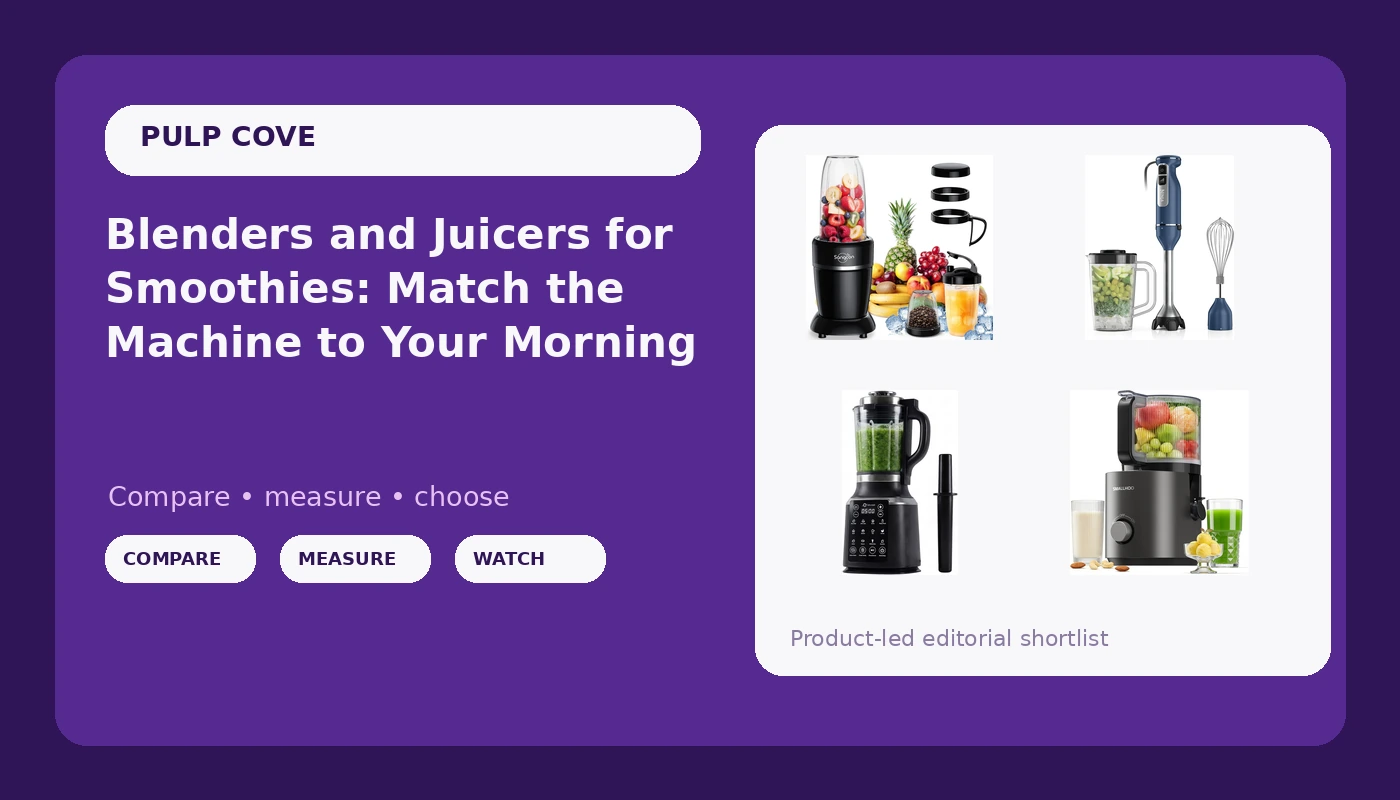
Every product page for blenders and juicers for smoothies promises the same thing: frozen fruit and ice turned velvety in seconds. What those pages leave out is that the machine which actually fits your kitchen is decided by your routine, not by the spec sheet. If you blend one protein shake at 6 a.m. and rinse the cup in the sink, a full-size pitcher with fourteen presets is a lot of countertop to wash before you have had coffee. If you juice greens every morning, a fast spinning machine leaves a surprising amount behind in the pulp. I run a six-stool smoothie stand in Portland, which means I have made the same drink a few thousand times and learned exactly which parts wear out first. This is how I think about the four machines below: what each one is built to do daily, and where each one asks you to compromise.
Related: Why Blades Dull and Smoothies Turn Grainy →
Quick answer
Match the machine to the job you do most often, then check the parts you will actually touch every day. The Sangcon 1000W personal blender is sized for one drink at a time and lists frozen fruit and ice crushing among its jobs. The Ninja immersion blender and whisk runs at four speeds and comes with a 4oz cup, so it blends in the vessel you already have. The 1500W glass blender with a tamper covers full-pitcher work and adds a heating function for soups, nut milk, and sauces. The 3-in-1 cold press juicer with a 7 inch chute and a 120oz capacity handles whole produce, plus nut milk and sorbet. None of these is a universal answer, and the labels on the box will not tell you which one your mornings can live with.
4 useful options
| Model | Best fit | What stands out |
|---|---|---|
| Sangcon 1000W Powerful Personal Smoothies Blender Frozen Fruit Ice Crushing | One drink at a time, small kitchens | 1000W motor in a personal, single-serve format built around frozen fruit and ice |
| Ninja Immersion Blender & Whisk, 4 Speeds, 4oz Cup, Deep Navy, CI201ND | Blending directly in a cup, pot, or bowl | Four speeds, a whisk attachment, and a 4oz cup in the box |
| Glass Blenders for Kitchen with Tamper, 1500W Motor, 9 Adjustable Speeds, 14 Preset Programs, High-Speed Heating Blender | Full pitchers, hot soups, nut milk, batch work | 1500W motor, nine speeds, fourteen presets, glass jar, and a tamper |
| 3-in-1 Juicer Machines, Cold Press Juicer 7" Large Chute & 120oz | Daily juice, whole produce, nut milk, sorbet | Cold press design, a 7 inch chute, and 120oz capacity for whole vegetables and fruit |
The single-serving pick: Sangcon 1000W Powerful Personal Smoothies Blender
The trade-off with any personal blender is the cup. You blend in the vessel you drink from, which saves a step, and the connection points between the base and the cup are the parts that take the abuse. That is where a personal blender ages: not the motor, but the collar that locks the cup to the base. If you make one drink a day, that is a reasonable place to put your money. If you are making four, you will spend your life unscrewing cups.
The blend-in-the-vessel pick: Ninja Immersion Blender & Whisk
An immersion blender changes the cleanup math more than any other tool here. There is no pitcher to disassemble, because the blending happens in whatever you already own. The limitation is texture: a handheld tool works best when the food is already soft or already in liquid, and it is not the machine for a dense frozen block of mango. If your routine is soups, sauces, protein shakes in a cup, and whipped cream at the holidays, this covers a lot of ground in one drawer.
The full-pitcher pick: Glass Blenders for Kitchen with Tamper
This is the one on the list built for volume. The tamper matters more than the preset count: a tamper lets you push ingredients toward the blades instead of overloading the jar and hoping the lid holds. The heating function is the feature that separates it from a plain smoothie blender, since it can carry a soup or a nut milk through the warm stage. The cost is countertop real estate and cleanup, both of which scale with jar size.
The juice-first pick: 3-in-1 Cold Press Juicer
The wide chute is the feature that decides whether you actually juice. If you have to quarter an apple before it fits, you will skip juicing on busy mornings. Cold press machines run slower than centrifugal juicers and are generally quieter and gentler on greens, and the trade-off is time and a second machine to store. If juice is a daily habit rather than an occasional glass, this is the category that earns its counter space.
Prices and availability may change. Product images, names, and retailer links must be matched by verified ASIN. Do not state a current price, rating, stock status, or measured result without current evidence.
What wattage does and does not tell you
Wattage is a ceiling, not a promise. A 1500W motor has more headroom than a 1000W motor, which matters when you are loading frozen fruit and ice into a full jar, but the number tells you nothing about how the blades are shaped, how the jar channels ingredients back down toward them, or how well the base holds the jar steady at full speed. Two machines with the same wattage can behave completely differently on the same frozen mango.
The number that actually decides whether you stay happy is blade condition. Sharp blades cut; dull blades smear. A dull blade pushes frozen fruit around the jar instead of slicing it, and the result is a drink with chewy flecks in it, what I call grainies. Every blade dulls eventually. The only question is whether that happens after twenty-five blends or after five years, and the answer depends on what you put through it. Ice, frozen fruit, and hard seeds are the expensive inputs. If you blend mostly soft fruit, yogurt, and liquid, your blades will last far longer than the box suggests.
Heat is the other hidden variable. Any high-speed blender generates friction heat in the jar, and a long run can warm your drink noticeably. That is a defect in a smoothie and a feature in a soup, which is exactly why a machine that lists a heating function is doing deliberately what a plain blender does by accident.
Cold press versus centrifugal: what changes in the glass
Centrifugal juicers spin a basket at high speed and use a mesh filter to separate juice from pulp. They are fast, they handle citrus and melon well, and they are usually the cheaper entry point. The limitation is greens: leafy vegetables give up their juice less willingly to a fast spin, and the pulp that comes out often still tastes like something.
Cold press machines crush and press slowly instead. Because there is less speed and less air whipped into the liquid, the juice tends to come out with less foam and stays drinkable a bit longer in the fridge. The cost is time and patience. A cold press run is a slower event, and you will notice it most on mornings when you are already late.
The practical rule: if you juice occasionally and mostly oranges, a centrifugal machine is fine. If you juice greens daily and care about yield, the slower machine is the one that survives the honeymoon phase.
How to choose in five steps
- Count your actual drinks per day. One drink points to a personal blender; four or more points to a pitcher or a dedicated juicer.
- List what goes in. Frozen fruit and ice demand a stronger motor and better blade geometry than soft fruit and yogurt.
- Decide where the blending happens. In a cup, in a pot, or in a jar. That single answer eliminates most of the field.
- Check the parts you will wash. A jar, a lid, a gasket, a mesh filter, and a pulp bin are all daily contact points.
- Measure your counter. A 120oz juicer and a full-size pitcher blender will not both live comfortably in a small kitchen.
Practical guidance
- Rinse immediately. Pulp and smoothie residue set like cement once they dry, and a five-second rinse beats a ten-minute scrub.
- Do not overload the jar. A lid that pops off mid-blend is almost always an overfilled jar, not a defective lid.
- Use the tamper instead of adding liquid. More liquid thins the drink; a tamper gets the stubborn top layer down to the blades.
- Keep frozen fruit portioned. Pre-portioning into bags means you load the jar instead of wrestling a brick of mango.
- Test the noise before you commit to a morning routine. A machine you run at 6 a.m. is a machine your household has to live with.
Which option should you choose?
Choose the Sangcon 1000W Powerful Personal Smoothies Blender when you make one drink at a time, want the smallest possible footprint, and would rather rinse a cup than wash a jar. Choose the Ninja Immersion Blender & Whisk, 4 Speeds, 4oz Cup, Deep Navy, CI201ND when you want to blend in the vessel you already own, whether that is a cup of protein shake or a pot of soup, and you value a whisk attachment for the same drawer. Choose the Glass Blenders for Kitchen with Tamper when you blend full pitchers, want preset programs to do the thinking, and need the heating function for nut milk, soups, and sauces. Choose the 3-in-1 Cold Press Juicer when juice is the point, you want to feed whole produce through a 7 inch chute, and you want nut milk and sorbet from the same machine.
One caveat applies to all four. Specs describe a machine on its first day, and the features listed above come from the product descriptions, not from a lab. How any of these holds up after twenty-five blends of frozen fruit is a question only your own routine will answer, and the honest way to judge it is to pay attention to texture over the first month, not the first week.
The bottom line
Buy for the job you do most, not the job you imagine doing. A personal blender that fits your morning is worth more than a full-size machine you avoid because of the cleanup. A juicer with a chute wide enough for a whole apple gets used; one that requires prep does not. And whatever you choose, watch the texture of your drinks over the first month, because that is where a machine tells you the truth about its blades.